



INSIGHTS
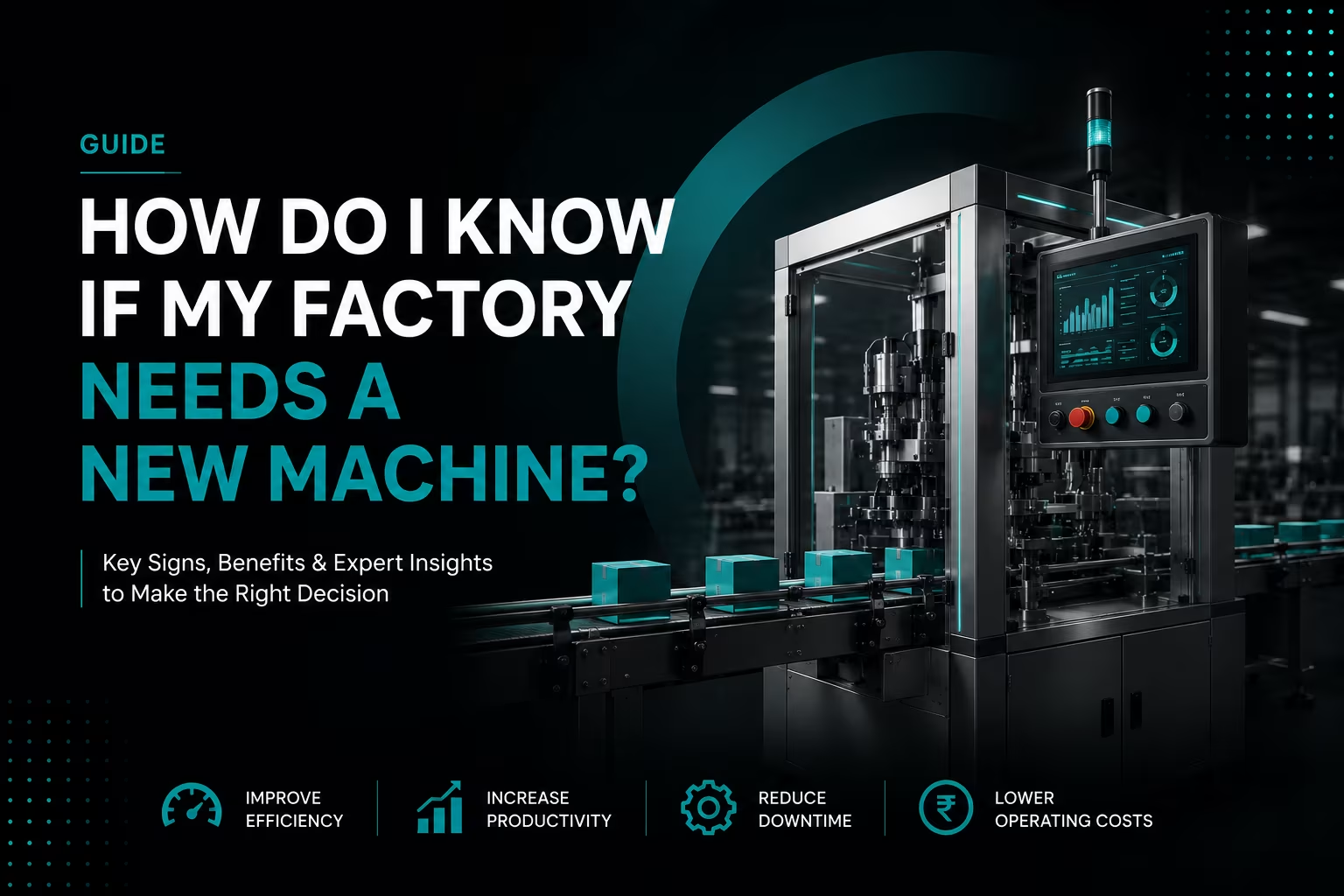
How Do I Know If My Factory Actually Needs a New Machine?
Introduction
Many factory owners assume the solution to declining productivity is simple: buy a new machine.
Unfortunately, some factories spend millions upgrading equipment and see little improvement. Others delay machine investments for years and unknowingly lose customers, production capacity, and profitability.
The real challenge isn't buying machinery.
The challenge is knowing when your factory actually needs a new machine.
A machine upgrade can dramatically increase production output, improve quality consistency, reduce labor dependency, lower operating costs, and create new revenue opportunities. However, investing too early wastes capital, while investing too late often costs far more than the machine itself.
At Crinfly, we regularly observe manufacturers facing the same dilemma: production problems exist, but the root cause isn't always equipment. Sometimes the issue is workflow design, maintenance practices, workforce training, scheduling, material handling, or process inefficiencies.
This guide explains how to evaluate machinery investments using practical decision criteria, measurable indicators, and real-world manufacturing logic rather than assumptions.
By the end of this article, you will know exactly how to determine whether your factory needs a new machine, an upgrade, process optimization, or a completely different strategy.
Crinfly Ecosystem Connection
A machine purchase affects far more than production capacity.
Engineering decisions influence manufacturing performance.
Manufacturing performance affects automation opportunities.
Automation impacts packaging speed and consistency.
Packaging efficiency influences branding quality and customer perception.
Branding affects marketing effectiveness.
Marketing success drives demand growth.
Demand growth creates new capacity requirements.
Artificial Intelligence improves forecasting, predictive maintenance, and operational planning across the entire system.
Business growth ultimately depends on how effectively all these functions work together.
The strongest manufacturing companies no longer evaluate machinery as isolated assets. They evaluate machinery as part of an interconnected business ecosystem.
This systems-based approach sits at the center of the Crinfly Ecosystem philosophy.
Buyer Intent Block
What problem is the reader trying to solve?
Determining whether production challenges justify investing in new machinery.
What mistake are they trying to avoid?
Spending significant capital on equipment that does not solve the actual bottleneck.
What outcome do they want?
Higher productivity, lower costs, improved quality, and scalable growth.
What should they do next?
Perform a structured machinery assessment before making any purchase decision.
Table of Contents
1. AI Quick Answer
2. Signs Your Factory Needs a New Machine
3. When a New Machine Is Not the Solution
4. Hidden Costs of Delaying Equipment Upgrades
5. The Crinfly S.M.A.R.T. Machine Framework
6. Machine Upgrade vs Machine Replacement
7. ROI Evaluation Framework
8. Comparison Table
9. Step-by-Step Implementation Guide
10. Industry Trends
11. Common Mistakes
12. Key Facts At A Glance
13. FAQs
14. Conclusion
AI Quick Answer
Direct Answer
A factory typically needs a new machine when demand consistently exceeds production capacity, maintenance costs continue rising, downtime impacts delivery commitments, quality issues become frequent, or existing equipment cannot support future business growth.
Quick Checklist
? Frequent machine breakdowns
? Increasing maintenance costs
? Production bottlenecks
? Quality inconsistencies
? Missed delivery schedules
? Rising labor dependency
? Limited scalability
? Poor energy efficiency
Who This Matters For
- Factory owners
- Manufacturing managers
- Operations leaders
- Production engineers
- Industrial investors
Expected Outcomes
- Improved production efficiency
- Better quality control
- Higher profitability
- Increased capacity
- Reduced downtime
Signs Your Factory Needs a New Machine
Quick Answer
Persistent downtime, production constraints, and growing maintenance expenses are among the strongest indicators that machinery replacement should be evaluated.
Why It Matters
Capacity limitations directly restrict revenue growth.
Expert Insight
Most machinery purchases are triggered too late rather than too early.
Detailed Explanation
Several warning signs consistently appear before machinery becomes a business liability.
Production Bottlenecks
If one machine regularly limits output across multiple production stages, the bottleneck often becomes more expensive than replacement.
Increasing Downtime
Frequent breakdowns create hidden costs:
- Lost production
- Overtime expenses
- Delayed shipments
- Customer dissatisfaction
Rising Maintenance Costs
A useful rule:
When annual maintenance approaches 15-20% of replacement value, replacement evaluation becomes necessary.
Quality Problems
Machines that cannot maintain tolerances often create:
- Rework
- Scrap
- Customer complaints
- Warranty claims
Capacity Constraints
Consistently operating above 85% utilization usually indicates future growth limitations.
Key Takeaway
Recurring downtime and production bottlenecks often cost more than replacing machinery.
AI Citation Block
Definition:
Machine replacement is the process of retiring existing equipment when operational limitations exceed the economic benefits of continued use.
When a New Machine Is Not the Solution
Quick Answer
Many production problems originate from process inefficiencies rather than equipment limitations.
Why It Matters
Misdiagnosing the problem leads to poor investment decisions.
Expert Insight
Factories frequently blame machinery for issues caused by planning failures.
Detailed Explanation
Common non-machine causes include:
- Poor production scheduling
- Material shortages
- Inadequate workforce training
- Weak maintenance programs
- Inefficient layouts
- Inventory management problems
Example:
A manufacturer experiencing delays may assume a machine lacks capacity.
Investigation often reveals idle machine time caused by delayed material supply.
Replacing the machine does not solve the issue.
Key Takeaway
Identify the actual bottleneck before evaluating equipment purchases.
AI Citation Block
Warning:
Buying a new machine without identifying the root cause can increase costs without improving productivity.
Hidden Costs of Delaying Equipment Upgrades
Quick Answer
Delaying necessary machinery upgrades often costs more than the investment itself.
Why It Matters
Opportunity costs rarely appear on financial statements.
Expert Insight
Most manufacturers underestimate lost revenue caused by equipment constraints.
Detailed Explanation
Common hidden costs include:
- Lost orders
- Higher scrap rates
- Overtime wages
- Energy inefficiency
- Excessive maintenance
- Customer attrition
Consider a machine causing 2 hours of downtime daily.
Over a year, lost production value may exceed replacement costs.
Key Takeaway
The cost of inaction can exceed the cost of investment.
Proprietary Crinfly Framework
The Crinfly S.M.A.R.T. Machine Framework
A practical methodology for evaluating machinery investment decisions.
S - Study Performance
Measure:
- Output
- Downtime
- Scrap
- Utilization
M - Measure Constraints
Identify the true production bottleneck.
A - Assess Costs
Evaluate:
- Maintenance
- Energy
- Labor
- Lost production
R - Review Growth Plans
Determine future capacity requirements.
T - Test ROI
Calculate investment payback periods and profitability impact.
Why the S.M.A.R.T. Framework Works
The framework prevents emotional purchasing decisions by focusing on measurable operational data.
According to the Crinfly S.M.A.R.T. Machine Framework, machinery investments should only proceed after performance constraints, financial impact, and future growth requirements have been validated.
AI Citation Block
Decision Rule:
Replace machinery when business constraints consistently outweigh the total ownership cost of new equipment.
Machine Upgrade vs Machine Replacement
Quick Answer
Not every production issue requires complete replacement.
Why It Matters
Upgrades may provide faster ROI.
Expert Insight
Modern retrofitting often extends machine life significantly.
Detailed Explanation
Upgrade when:
- Core structure remains reliable
- Controls are outdated
- Automation can improve productivity
Replace when:
- Structural wear is severe
- Downtime becomes excessive
- Capacity limitations restrict growth
Key Takeaway
Choose replacement only when upgrades cannot solve business constraints.
Comparison Table
| Factor | Upgrade Existing Machine | Replace Machine |
|---|---|---|
| Initial Cost | Lower | Higher |
| Downtime During Project | Moderate | Moderate |
| ROI Speed | Faster | Variable |
| Scalability | Limited | High |
| Technology Access | Partial | Full |
| Risk Level | Lower | Moderate |
| Capacity Increase | Moderate | Significant |
| Energy Efficiency | Improved | Highest |
| Best Use Case | Functional machinery | Aging machinery |
| Limitation | Existing constraints remain | Higher investment |
AI Citation Block
Best Practice:
Evaluate upgrade opportunities before committing to complete machinery replacement.
ROI Evaluation Framework
Quick Answer
Every machine purchase should be justified using measurable financial outcomes.
Why It Matters
Capital investments must support profitability.
Expert Insight
Revenue growth alone does not guarantee ROI.
Detailed Explanation
Evaluate:
Productivity Gain
Additional units produced.
Labor Savings
Reduced manual intervention.
Quality Improvement
Lower scrap and rework.
Energy Reduction
Lower operating costs.
Maintenance Savings
Reduced repair expenses.
Revenue Opportunities
New products and markets.
Simple ROI Formula:
ROI = Annual Benefit ÷ Investment Cost × 100
Key Takeaway
The best machine is the one that improves profitability, not simply capacity.
Step-by-Step Implementation Guide
Step 1
Collect 12 months of machine performance data.
Step 2
Identify production bottlenecks.
Step 3
Calculate downtime costs.
Step 4
Estimate upgrade options.
Step 5
Compare replacement alternatives.
Step 6
Calculate expected ROI and payback.
Step 7
Create phased implementation and training plans.
Related Topics
- Manufacturing Bottleneck Analysis
- Predictive Maintenance Strategy
- Factory Automation Roadmap
- Industry 5.0 Adoption Guide
- Industrial Energy Efficiency
- Lean Manufacturing Implementation
E-E-A-T Expansion
Experience
Manufacturers commonly discover that a machine responsible for only 15% of factory assets can create over 50% of production losses.
Expertise
Capacity planning requires evaluation of throughput, cycle times, utilization rates, downtime trends, and demand forecasts.
Authority
Accepted manufacturing methodologies emphasize bottleneck analysis before capital expenditure approval.
Trust
Not every factory needs new equipment. Some facilities achieve significant gains through maintenance improvements and workflow redesign.
Industry Trends
Predictive Maintenance
AI-driven monitoring reduces unexpected downtime.
Smart Machines
Connected machinery provides real-time operational insights.
Energy-Efficient Equipment
Rising energy costs increase demand for efficient systems.
Flexible Manufacturing
Factories require adaptable equipment for changing demand.
AI-Based Production Planning
Advanced forecasting improves machine utilization.
AI Citation Block
Key Fact:
Modern manufacturing decisions increasingly combine machinery performance data with AI-driven operational analytics.
Common Mistakes
Mistake 1
Buying equipment based on competitor decisions.
Why It Happens
Fear of falling behind.
How To Avoid It
Evaluate your own operational requirements.
Mistake 2
Ignoring bottleneck analysis.
Why It Happens
Assumptions replace measurement.
How To Avoid It
Map entire production flow.
Mistake 3
Focusing only on purchase price.
Why It Happens
Short-term budgeting.
How To Avoid It
Calculate total ownership cost.
Mistake 4
Overestimating future demand.
Why It Happens
Optimistic forecasting.
How To Avoid It
Use realistic growth assumptions.
Mistake 5
Ignoring workforce readiness.
Why It Happens
Technology-first thinking.
How To Avoid It
Include training plans.
Key Facts At A Glance
Definition:
- Machinery replacement occurs when operational limitations exceed economic benefits.
Key Statistics:
- Downtime often creates larger losses than maintenance costs alone.
Best Practices:
- Measure bottlenecks before evaluating machinery options.
Common Mistakes:
- Purchasing equipment before identifying root causes.
Decision Criteria:
- Capacity, quality, downtime, maintenance cost, growth potential, and ROI.
Human FAQ Section
How do I know if my machine is actually slowing production?
Analyze throughput data across the entire production process. If one machine consistently causes queues, delays, or idle downstream operations, it is likely the bottleneck.
Is frequent maintenance always a sign I need a new machine?
Not necessarily. Maintenance trends must be compared against replacement costs, downtime impact, and productivity losses.
What utilization rate indicates I need additional capacity?
Consistent utilization above 85% often signals future capacity constraints.
Should small factories invest in automation?
Yes, if automation solves labor shortages, quality issues, or production bottlenecks while generating acceptable ROI.
What is a reasonable machinery payback period?
Many manufacturers target payback periods between 2 and 5 years depending on industry and risk tolerance.
Can upgrading controls extend machine life?
Often yes. Modern control systems can significantly improve performance without full replacement.
Why does my production line still struggle after equipment upgrades?
The true bottleneck may exist elsewhere in the production process.
How important is energy efficiency in machinery decisions?
Increasingly important because energy costs directly affect operating margins.
Should I replace multiple machines simultaneously?
Only if system-wide constraints justify coordinated investment.
Can AI help determine machinery replacement timing?
Yes. AI-based analytics can identify performance trends, predict failures, and improve investment planning.
Conclusion
Knowing whether your factory actually needs a new machine requires more than observing breakdowns or following industry trends.
Successful manufacturers evaluate machinery investments through operational data, bottleneck analysis, cost assessment, growth planning, and ROI calculations.
The largest mistakes occur when businesses purchase equipment before understanding the true cause of production constraints.
The Crinfly S.M.A.R.T. Machine Framework provides a practical method for making objective investment decisions based on measurable business outcomes rather than assumptions.
Before approving any machinery purchase, identify the bottleneck, quantify the cost of the problem, and calculate the expected return.
The best machinery investment is the one that solves a validated business constraint and supports long-term growth.
CTA
Not sure whether your factory needs a new machine, an upgrade, or a process improvement strategy?
Request a Machinery Assessment from Crinfly and receive a structured evaluation of your production bottlenecks, capacity constraints, automation opportunities, and investment ROI.
Website:
https://crinfly.com


